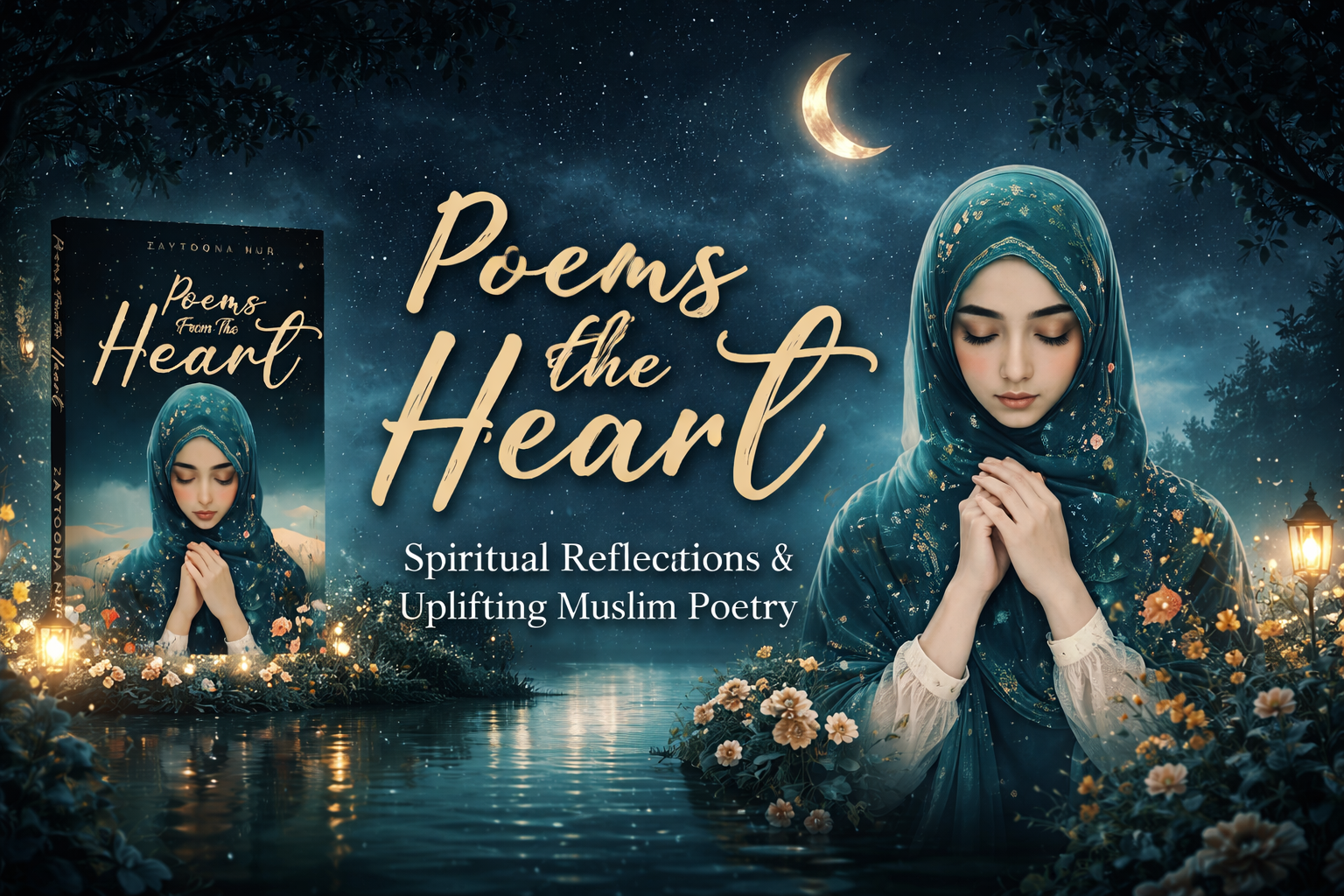
“Poems from the Heart” by Zaytoona Nur is a collection of reflective Muslim poetry that explores themes of faith, identity, gratitude, and devotion to Allah. She is well known for her love of Islamic poetry, and among these poems, the one we offer here is perhaps the most important. Nur’s work stands out for “the melancholic sweetness of her passionate soul, for the elegant pessimism of her attitude toward life, and for the colorful emotion that animates her poignant inner life.”
Poems from the Heart offers gentle insights and reminders of Islamic values, particularly resonating with women seeking spiritually uplifting and honest verse. Yes, it’s said that poetry doesn’t change the world, but in these times of a lack of empathy, where selfishness and groupthink prevail, it proves to be one of the most beautiful forms of rebellion. Sometimes, even an antidote. Zaytoona Nur invites readers to contemplate, find peace, and reconnect with their faith through heartfelt, accessible poetry.
Unlock the Secrets of Islamic Verse
In Arabic, Islam means “submission,” that is, submission to the will of God. It also means “entering into peace,” specifically, the peace found through submission to God’s will. Muslims accept five main obligations in life, commonly referred to as the “Five Pillars of Islam.” In practice, of course, Muslims can be seen carrying them out in different ways and to varying degrees, as the responsibility for fulfilling each one rests on the shoulders of each individual. It is also important to note that the poet’s work was respected and imbued with a mystical quality, which likely explains its status in Islam as a divine instrument, given its beauty and depth.
Zaytoona Nur expresses how poetry is one of the oldest art forms in the Islamic world; in fact, its development began before Muhammad received the revelation of Allah’s word, during the so-called Age of Ignorance, when it was primarily disseminated through oral tradition. This art is so significant in their culture that, for them, “poetry is the memory of the Arabs”. However, although this may seem like a stark statement, its creation and development flourished in many languages associated with Islam, such as Persian, Ottoman Turkish, and even Urdu.
In Poems from the Heart, an interrelationship with other artistic disciplines is evident.
Poetry reflects the general characteristics of Islamic art (eclecticism, iconoclasm, stylization, and mutability); However, it’s important to highlight that among its main characteristics is its use of metaphors and symbolism, alluding to recurring images such as flowers, a garden, or love—the latter, for example, representing the idea of a lover who desires to surrender to the divinity of Allah.
With Poems from the Heart, Zaytoona Nur characterizes Islamic poetry is its thematic focus, which invariably refers to spiritual and mystical aspects, such as the inner search, renunciation of the material, mystical ecstasy, and transcendence through divinity. This is possibly why meter is such a relevant aspect of poetry: it is considered impossible to translate, as doing so would destroy its structure and authenticity, thereby ruining its beauty.
Poetry was the first development of Arabic literature, and the qasida was its finest form of expression from the pre-Islamic era, known as Jahiliyyah or the “age of ignorance,” the period of ancient pagan Arabia that ended with the revelation of the Prophet Muhammad. Likewise, the best-known forms include the qasida (long ode), the ghazal (Persian love lyric), and the rubaiyat (Persian quatrains). Of these, the qasida is probably the most widespread, consisting of 30 to 120 lines of identical meter with the same closing rhyme.
Why Poetry Matters: Beyond Words
Nur’s style of poetry is an art form valued for centuries for its beauty and ability to move people. However, it also has lesser-known but equally important benefits, especially regarding emotional development and mental health. In Poems from the Heart, readers will explore how poetry is undoubtedly a valuable tool for improving emotional well-being and for fostering the holiness of Allah.
Furthermore, Nur’s poetry fosters a connection with the Almighty, the development of empathy, and compassion. By reading Poems from the Heart, one can put oneself in another person’s shoes and understand their thoughts and feelings. This naturally fosters a greater awareness of others’ perspectives and experiences, which can naturally strengthen empathy and compassion with the divine source. Therefore, it can help people develop essential social and emotional skills for healthy relationships.
Zaytoona questions: about faith? For many, it is the cornerstone, an unwavering stability.
Islam defines faith as the complete assurance that we will receive something we cannot even see. We wait with confidence and peace because we know in whom we have believed. Of course, our faith is placed in Allah, and the closer we draw to Him, the more we grow in faith.
Faith: The Cornerstone of Spiritual Life
As Muslims, we have the powerful privilege of prayer. We know that prayer is important and should be a part of our daily lives. And yet, praying isn’t always easy.
Using Your Own Words
The Quran, however, makes it clear that we can also use our own words in our prayers. There are no set rules regarding the length or content, much less the exact wording of our prayers. We find many examples of prayers that are tailored to a particular occasion, expressing someone’s personal emotions or concerns, and that would not be suitable for others to copy in different circumstances. This is absolutely fine. Prayer can be a very personal communication with Allah- the Creator of the universe.
Did You Know? Your Words Matter in Prayer
Books can be a powerful tool for rekindling faith in times of doubt. By reading inspiring stories of people who have overcome challenges and found purpose in life through their faith, readers can find strength and hope.
Key Takeaways from Poems from the Heart
“Poems from the Heart” by Zaytoona Nur reminds us that we are not alone in our struggles and that a higher power guides us and enables us to overcome any obstacle. They also provide us with knowledge, inspiration, and a deep connection to our spirituality.
While reading sacred texts can help us reconnect with our faith, find comfort in difficult times, and strengthen our relationship with the divine, there are also works that invite us to reflect on our lives, our values, and our beliefs, offering ethical and moral guidance for living in accordance with our spiritual principles.
Therefore, today we recommend “Poems from the Heart” to help you rekindle your faith.